
Spades is built for four players in two partnerships, but it adapts surprisingly well to just two. The trick is that you can’t simply deal out the cards and play, because with only two hands most of the deck would go to waste and there’d be no skill in how you got your cards. So two-player Spades uses a clever draw-and-discard method to build each hand, and that little twist is what makes the two-handed game its own thing. Here’s how to play it from start to finish.
The actual playing, bidding, and scoring are nearly identical to the standard game, so if you haven’t learned that yet, read the Spades rules page first. This page focuses on what’s different when it’s just the two of you.
Setting Up a Two-Player Game
All you need is a standard 52-card deck with the jokers removed, same as always. The card ranking is the same too, ace high down to the two, and spades are still trump. Decide who deals first however you like. The only real difference at this stage is that nothing gets dealt out. Instead, the deck goes face down in the middle of the table as a draw pile, called the stock, and you build your hands from it one card at a time.
Building Your Hand: The Draw
This is the heart of two-player Spades, so it’s worth reading slowly. The non-dealer goes first.
On your turn, take the top card off the stock and look at it. If you want it, add it to your hand, then take the very next card off the stock and place it face down on a discard pile without using it. If you don’t want that first card, do the opposite: set it face down on the discard pile, then take the next card off the stock, and that one you have to keep. Either way, each turn you see two cards from the stock and keep exactly one of them.
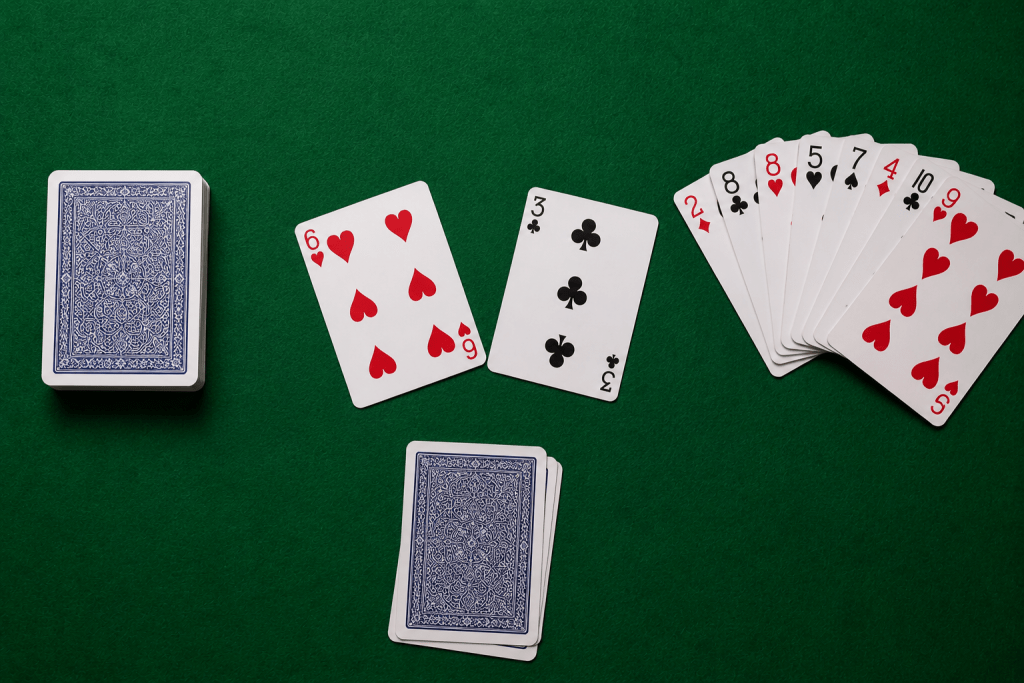
You and your opponent alternate turns like this, drawing and discarding, until the stock runs out. By the time it does, each of you will be holding 13 cards, and the 26 cards in the discard pile are out of play for that hand. The part that makes it interesting is that you never see which cards your opponent kept or threw away, so paying attention to what comes off the stock, and remembering it, becomes a real edge.
Bidding With Two Players
Once both hands are built, you bid. With no partners, each player simply bids for themselves, naming how many of the 13 tricks they expect to win. The two bids don’t have to add up to anything in particular, and the non-dealer usually bids first.
You can play with Nil bids if you both agree to, but be warned that Nil is far riskier two-handed. In the four-player game a partner can cover you and take the tricks you need to dodge. With only two of you, there’s no one to help, so a Nil rests entirely on your own hand being safe.
Playing the Hand
From here it plays just like regular Spades. The non-dealer leads the first trick with any card except a spade, since spades still have to be broken before they can be led. You follow suit if you can, and whoever plays the highest spade wins the trick, or the highest card of the led suit if no spade appears. The winner leads the next one, and you work through all 13 tricks. The full detail of trick play and the breaking rule is on the Spades rules page if you need a refresher.
Scoring and Winning
Scoring is identical to the standard game. Make your bid and you score 10 points for each trick you bid, plus one point for any overtrick, which still counts as a bag. Miss your bid and you’re set, losing 10 points for every trick you bid. Bags still pile up on a running tally, and ten of them still cost you 100 points. Most two-player games are played to 500, the same as the full game, though you can pick a lower target like 250 for a quicker match.
Strategy Tips for Two-Handed Spades
Two-player Spades rewards a sharp memory more than the four-player game does. Half the deck gets discarded during the draw, so the cards in play are a smaller, knowable pool. If you track which high cards and how many spades have already shown up, you can bid and play with far more confidence than your opponent.
A few quick pointers. Lean on your high spades to control the hand, since there’s no partner to lean on instead. Bid a little conservatively, because there’s no one to cover an optimistic bid that goes wrong. And think twice before going Nil, given how exposed you are without a partner. Beyond that, the same habits that win the four-player game will serve you here.
If you’ve got three players rather than two, there’s a different no-partners version worth trying, covered on the Cutthroat Spades page. And for the many other ways people tweak the game, the house rules and variations page rounds them up.