
Scoring is the part of Spades that scares off new players, and it really shouldn’t. There’s a bit of arithmetic involved, but it all flows from one simple idea, and once you’ve kept score for a hand or two it turns into second nature. This page breaks the whole thing down piece by piece, with a worked example for each, so the numbers stop being a mystery.
If you need the rules of bidding and play first, those live on the Spades rules page. Everything here assumes you already know how a hand is bid and played.
The One Idea Behind Scoring
Here’s the idea the entire system rests on: you score for hitting your bid, not for winning tricks. A team that bids carefully and lands on its number will out-score a team that grabs every trick it can. That’s the whole philosophy of the game, and it’s why choosing a good bid matters so much. If you haven’t read it yet, the Spades bidding page covers how to count your hand into a sensible number.
Each hand, your bid and your partner’s bid add together into one team total. At the end of the hand you compare the tricks you actually won against that combined bid, and the score falls out of the difference. Let’s walk through every case.
Making Your Bid
When your team takes at least as many tricks as it bid, you score 10 points for each trick you bid. The number you bid is what counts here, not the number you took.
Say you bid 4 and your partner bids 3, for a team total of 7. You play the hand out and win exactly 7 tricks between you. Your score is 7 times 10, which is 70 points. Simple as that. Hitting your bid on the nose is the cleanest result in the game, and it’s what you’re aiming for every hand.
Overtricks and Bags
What happens when you take more tricks than you bid? Those extra tricks are called bags, and each one is worth a single point.
Suppose your team bids 5 and ends up winning 8 tricks. You get 50 points for making your bid of 5, plus 3 points for the 3 extra tricks, for a total of 53. So far that looks like a small bonus, and for one hand it is.
The catch is that bags don’t go away. They sit on a running tally, and the moment your team collects 10 of them across the game, you lose 100 points in a single stroke. That penalty is the reason experienced players refuse to scoop up tricks they didn’t need. There’s real skill in steering clear of it, and the full story, along with how to avoid the penalty, is on the bags and sandbagging page.
Getting Set (Missing Your Bid)
Falling short of your bid is called getting “set,” and it’s the result you want to avoid. If your team doesn’t reach its combined bid, you score nothing for the tricks you won. Instead, you lose 10 points for every trick you bid.
Picture a team that bids 6 but only manages 4 tricks. They don’t score 40 for those 4 tricks. They’re set, so they lose 60 points, which is 10 for each of the 6 tricks they promised. This is exactly why overbidding is so costly, and why a slightly cautious bid usually pays off. One greedy bid that misses can wipe out two or three careful hands.
Scoring a Nil
A Nil bid scores on its own, separate from the normal trick math. When a player bids Nil and wins no tricks at all, their team gets 100 points, added on top of whatever the partner scores for their own bid.
So if you bid Nil and go clean while your partner bids 4 and makes it, your team scores 40 for the partner’s tricks plus 100 for the Nil, a healthy 140 points for the hand. If the Nil fails, meaning you slip and take even one trick, your team loses 100 points instead, and each trick you took becomes a bag. Your partner’s bid is still scored on its own. Blind Nil, declared before you look at your cards, doubles everything to 200 points either way. The full picture of how Nil works, and how to play one safely, is on the Nil and Blind Nil page.
A Full Round, Scored
Examples one at a time are useful, but it helps to see a whole hand scored at once, both teams together. So here’s a complete round.
Team A bids 7 between its two players. Team B bids 5. There are 13 tricks in the hand, and when it’s all played out, Team A has won 8 of them and Team B has won 5.
Team A bid 7 and took 8. They make their bid, scoring 70, plus 1 bag for the extra trick, for 71 points that hand. They also add that 1 bag to their running tally to watch later.
Team B bid 5 and took 5. They hit their number exactly, scoring 50, with no bags at all. A clean hand.
Written on a score sheet, that round looks like this:
- Team A: 71 (1 bag)
- Team B: 50 (0 bags)
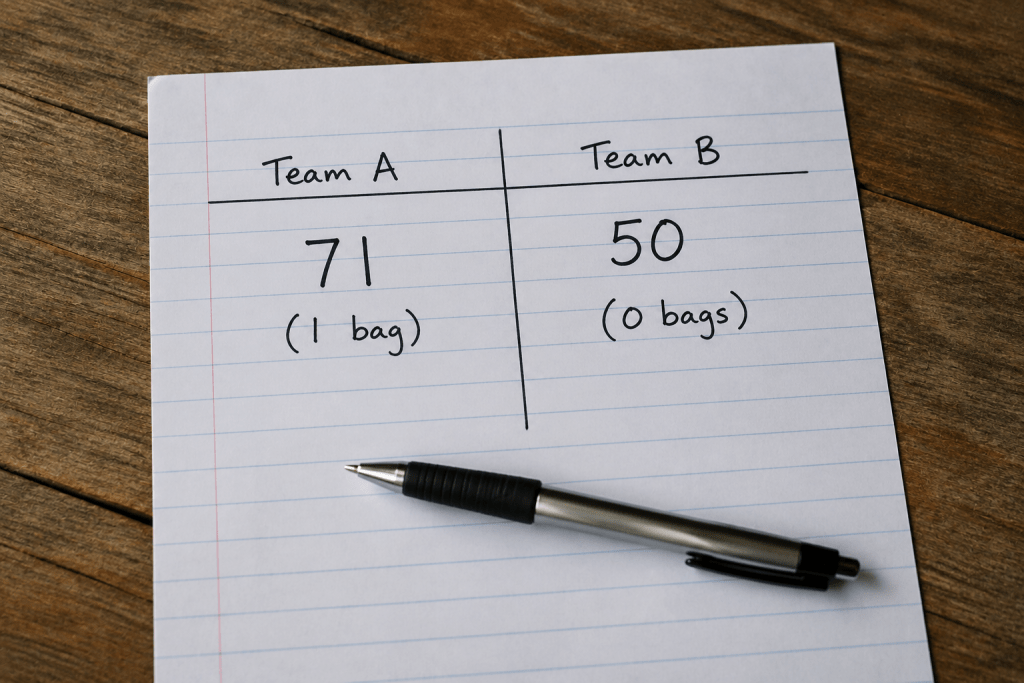
Notice that the 8 tricks Team A won and the 5 tricks Team B won add up to 13, the full hand. That’s always your check: the tricks have to total 13. Tally those scores onto each team’s running total, pass the deal to the left, and deal the next hand.
Keeping Score and Reaching the Target
In practice, one person keeps the score sheet, usually with a column for each team’s running total and a small note tracking each team’s bags. After every hand you add or subtract that hand’s result, update the bag count, and check whether anyone has crossed 10 bags and owes the 100-point penalty.
You keep doing this, hand after hand, until one team reaches the winning total, which most groups set at 500 points. How many points it takes to win, how long that usually takes, and the shorter targets some players prefer are all covered on the how many points to win page. Get comfortable with the five cases above and a score sheet will never slow your game down again.