
More games of Spades are won and lost in the bidding than in the play. You can hold a great hand and still bleed points by promising too much, or hold an ordinary one and score every round because you knew exactly what it was worth. Bidding well is the most useful skill in the game, and the good news is that it’s mostly counting, not guesswork.
This page shows you how to look at 13 cards and turn them into a sensible number, how to bid alongside a partner, and where the usual traps are hiding. If you’re still getting comfortable with how a hand flows, the how to play page covers that part first.
How Bidding Works
Once the cards are dealt, and before anyone plays, every player predicts how many tricks they expect to win. Starting with the player to the dealer’s left and going clockwise, each person says a number out loud. You can’t pass, and unlike a lot of card games, your bid doesn’t have to be higher than the person before you. Four players might bid 2, 5, 3, and 4 in any order.
Your bid and your partner’s bid are added together, and that total is your team’s contract for the hand. If you bid 4 and your partner bids 3, your side is trying to win 7 tricks between you. The full rules of bidding and play are on the Spades rules page; here we’re focused on the harder question, which is what number to say.
Counting Your Hand
The trick to bidding is to stop guessing and start counting. Sort your hand by suit and work through it in this order.
Start with your near-certain winners. The ace and king of spades are about as safe as cards get, since they’re the two highest trumps in the deck. Aces in the other three suits usually win too. Count each of these as one trick to begin with.
Next, add for long spades. Because spades are trump, the extra ones in your hand tend to win after everybody else’s trumps have been played out. A hand with five or six spades is worth more than just its high cards, so a run like A-K-9-6-3 might be good for four or five tricks once the dust settles, not just the two at the top.
Then add for short suits. If you’re void in a suit, or down to a single card, you’ll be able to trump that suit early with a spade. A void backed by a few spare trumps is a quiet little trick-making machine, and beginners almost always undervalue it.
Be careful with kings and queens on their own. A king wins when the ace is already gone, or when you have a low card to throw underneath the ace first and save the king for later. A bare king with nothing to protect it often just loses to the ace. Queens are rarely worth counting unless they come with backup.
When you’ve added it all up, shade the total down by a touch. Hands almost never play out as neatly as they look on paper, and a slightly cautious count will serve you far better than an optimistic one.
Choosing Your Number
Here’s why caution pays. If your team misses its bid, you don’t just lose the extra, you lose the whole hand: 10 points for every trick you bid, with nothing to show for the tricks you did win. The exact math is on the Spades scoring page, but the short version is that overbidding by one trick can swing a hand by 70 or 80 points.
Taking too few isn’t free either. Tricks you win beyond your bid become bags, and ten bags across a game cost you 100 points in one hit. So there’s a narrow target you’re aiming for: bid enough that you’re not stuck with a pile of bags, but never more than the cards can actually deliver.
Most groups also set a floor, often a minimum team bid of 4, so you can’t simply bid 1 and play it safe all night. Within all that, a good rule for newer players is to bid what you can defend and resist the urge to round up. A solid 3 that you make every time beats a hopeful 5 that you miss half the time.
Bidding With a Partner
Spades is a team game, so your bid isn’t only about your own hand. The two of you are pooling your predictions, and once the contract is set you both play to make the total, covering for each other along the way.
A few partnership habits worth building early. Don’t both count on the same trick, which usually means both of you leaning on the same suit to come good. Listen to what your partner’s bid is telling you, because a high bid says they’ll carry the load this hand, while a low one says they’re leaning on you. And keep half an eye on the table total: add up all four bids, and if they come to fewer than 13, the leftover tricks have to land somewhere, and they often pile up as bags. If the four bids add up to well over 13, somebody is getting set this hand, so it’s worth working out whether that somebody is likely to be you.
The Nil Bid and Bidding Zero
There’s one more option: a bid of zero, called Nil. It’s a promise to win no tricks at all that hand, and it’s worth a big bonus if you pull it off and an equally big penalty if you slip up and take even one. A hand full of low cards, with no aces and only small spades, is the classic Nil candidate, since it’s a hand that struggles to win tricks anyway.
Nil is powerful but it’s a real gamble, and there’s more to bidding and protecting one than fits here, so the Nil and Blind Nil page covers it on its own. Until you’re comfortable, there’s no shame in bidding a plain 1 or 2 with a weak hand instead.
Three Example Hands
Counting makes a lot more sense with cards in front of you, so here are three hands and the bids I’d make with each.
A steady, average hand:
- Spades: A, 7, 3
- Hearts: K, Q, 5
- Diamonds: A, 9, 4
- Clubs: J, 8, 6, 2
The ace of spades is a sure trick and the ace of diamonds should be another. The king and queen of hearts together are worth a maybe, since you can duck the ace and win the second round. That’s roughly two solid tricks and a hopeful third. Bid 2 or 3. I’d lean to 3 only if I felt good about that heart.
A spade-heavy hand:
- Spades: A, K, Q, 8, 6
- Hearts: 4, 2
- Diamonds: K, 7, 3, 2
- Clubs: 9, 5
Three top trumps, plus two more spades that should win once the other trumps are drawn out. The doubletons in hearts and clubs mean you’ll be void early and can trump in. The king of diamonds is a bonus. Bid 5, maybe 6. This is the kind of hand that wins games.
A weak hand:
- Spades: 5, 3, 2
- Hearts: 9, 6, 4, 2
- Diamonds: 8, 5
- Clubs: Q, 7, 4, 3
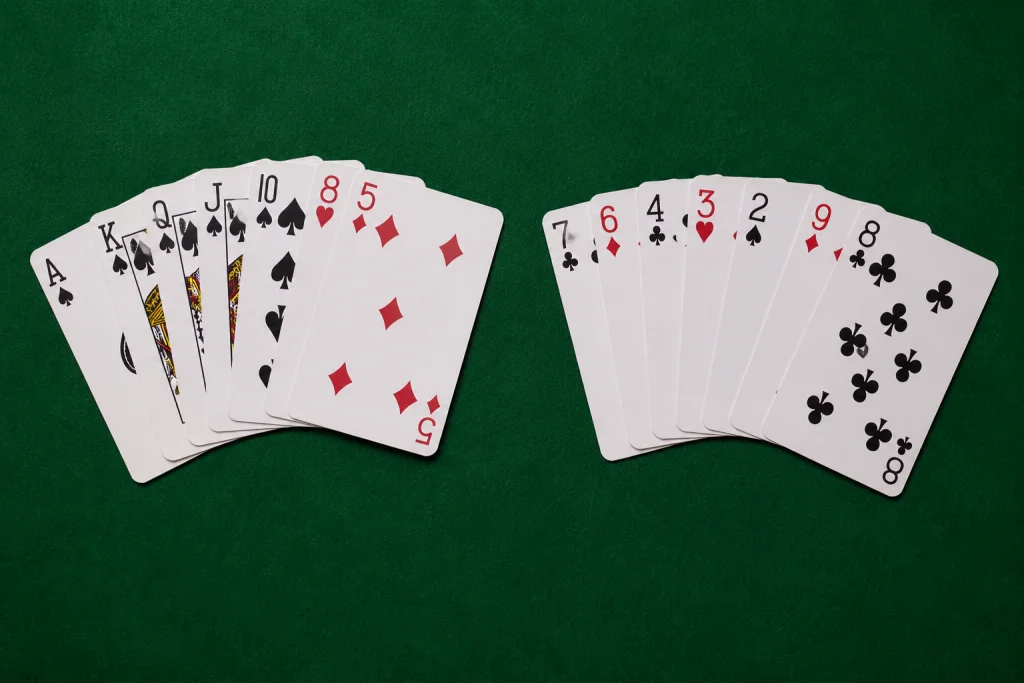
No aces, no high spades, nothing that reliably wins a trick. Bid 0 or 1. A hand this low is also a Nil candidate, though that loose queen of clubs is exactly the kind of card that can sneak a trick and bust the Nil, so it’s a judgment call.
Bidding Gets Easier
Counting your hand feels slow the first few times and then becomes almost automatic. Bid a little under what you think you see, pay attention to your partner’s number, and you’ll already be ahead of most casual players. When you’re ready to put the bidding together with smarter play, partner coverage, and bag control, the Spades strategy guide picks up from here.